Air Purifiers
Air Purifiers: A Side-by-Side Look
Compare 3 air purifiers side by side: Levoit Core 300, Coway Airmega 100 and Blueair Blue Pure 311 Auto — pros, cons, specs, and retailer links, with no…
How we picked these products
We compare product identity, specifications, pros/cons and retailer links. Until approved retailer API access is available, current Amazon price, star-rating and review-count data are not republished here.
Choose by what matters
Jump straight to what fits your situation — use-case chips point to products that match those features. Price/rating leader chips stay off until approved API data is available.
We don't crown a single "best" pick — this table lays out what's factually true about each option, side by side.
| Product | Check current price |
|---|---|
| Levoit Core 300 | Check current price(paid link) |
| Coway Airmega 100 | Check current price(paid link) |
| Blueair Blue Pure 311 Auto | Check current price(paid link) |
Air purifier marketing runs on square-footage claims, but those numbers are computed at different air-change rates and rarely compare across brands. What you are really choosing is air-change speed versus a built-in air-quality display versus running cost.
Levoit Core 300

Specs & pros/cons
Key specs:
- 3-in-1 filter: pre-filter, True HEPA, activated carbon
- Smoke CADR ~143 CFM, covers up to ~1,095 sq ft with the right air-change rate
- 24dB quiet sleep mode
- AHAM Verifide certified
Pros:
- Compact, cylindrical design fits small rooms/bedrooms easily
Cons:
- Lowest CADR/coverage of the two, weakest fit for large rooms
- No smart/WiFi control on this base model (separate Core 300S-P exists for that)
- Plastic housing feels less premium than the Coway's
Short version: Compact mechanical air purifier for small rooms. Official current specs: 143 CFM CADR, 222 ft² at 4.8 ACH / 1,066 ft² at 1 ACH, 56 W, 24–54.5 dB, 8.7 × 8.7 × 14.2 in, 7.9 lb.
Coway Airmega 100

Specs & pros/cons
Key specs:
- 3-stage filtration: mesh pre-filter, True HEPA, deodorization/carbon filter
- Covers up to 810 sq ft
- Real-time AQI air-quality monitor with color indicator
- Auto mode, timer, filter-change indicator, night light
Pros:
- Built-in real-time AQI monitor, which the Levoit Core 300 lacks
- Larger room coverage than the Levoit Core 300
- Long-standing brand with a strong independent lab-test track record
Cons:
- Larger footprint than the compact Levoit Core 300
- Replacement filter cost is higher than Levoit's
Short version: The Airmega 100 is a compact cylindrical purifier aimed at bedrooms, offices and other small rooms. For meaningful particle cleaning, treat it as roughly a 167–222 sq ft purifier at ~5 ACH, not an 810 sq ft whole-room solution.
Blueair Blue Pure 311 Auto
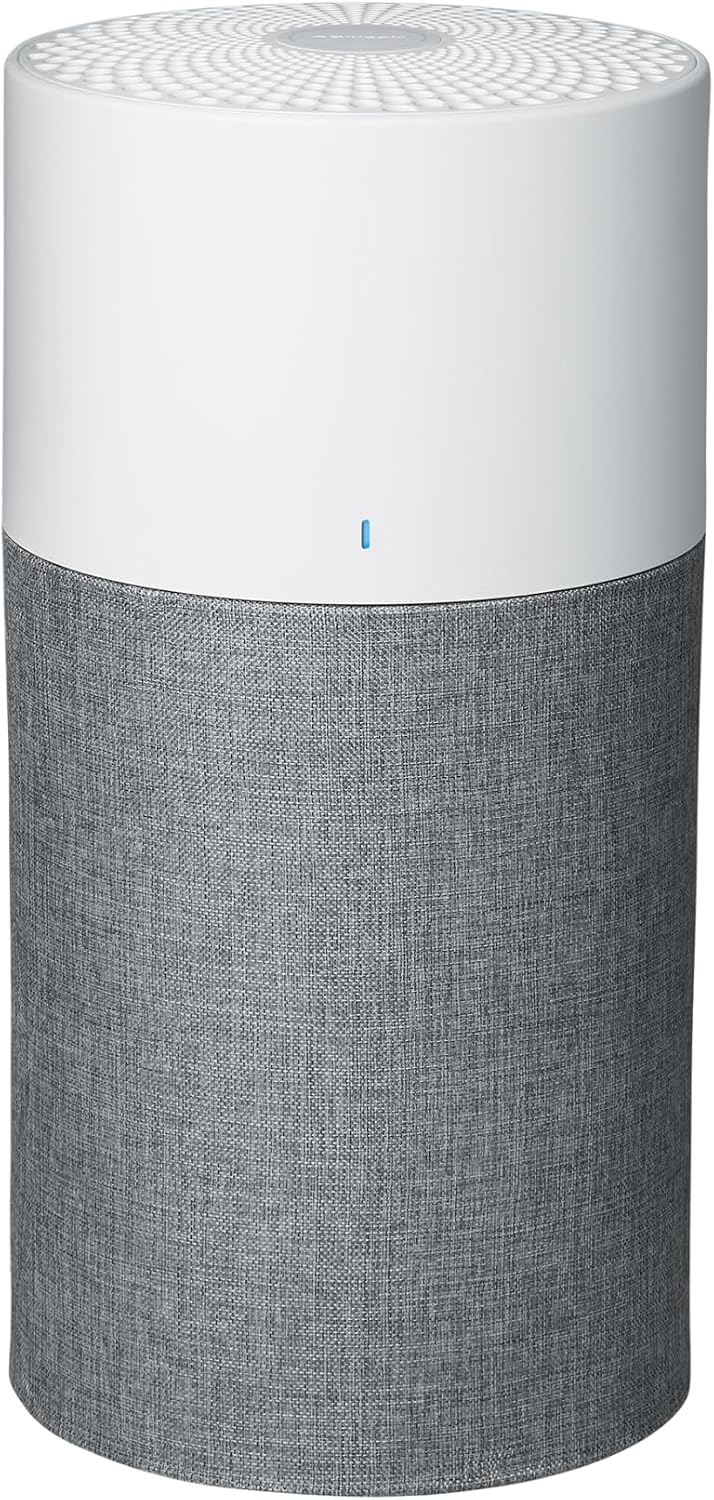
Specs & pros/cons
Key specs:
- HEPASilent dual filtration (mechanical + electrostatic)
- CADR ~244 dust / 250 smoke / 250 pollen (CFM)
- Washable fabric pre-filter (reduces replacement-filter frequency)
- One-click auto mode, as low as 23dB
Pros:
- Highest CADR of the three, fastest air-change rate for a given room size
- Quietest rated minimum noise level of the three
Cons:
- No built-in AQI display, unlike the Coway
- Fabric pre-filter needs regular hand-washing/maintenance
CADR beats coverage claims
The Levoit Core 300's listing claims coverage up to about 1,095 sq ft, yet its documented smoke CADR is around 143 CFM -- versus roughly 250 CFM for the Blueair Blue Pure 311 Auto -- because the two coverage suggestions assume different air-change rates. CADR is the closest thing to an apples-to-apples number in this set, and it is why the Blueair clears a given room noticeably faster despite costing more. The Coway Airmega 100 does not publish a CADR in its listing but documents 810 sq ft of coverage plus a real-time AQI color indicator, an extra neither rival offers.
The cost hiding in the filter
Noise floors are close where documented -- 24 dB on the Levoit's sleep mode, as low as 23 dB on the Blueair -- so both can share a bedroom. The Levoit's base model also skips smart/WiFi control entirely; the separate Core 300S-P exists for that.
Bottom line
Frequently asked questions
What does CADR actually measure, and how do I use it to size a purifier?
CADR (Clean Air Delivery Rate) measures how many cubic feet of air per minute a purifier can effectively clean of a specific pollutant, usually reported separately for dust, smoke, and pollen. A common sizing rule is matching CADR to roughly two-thirds of your room's square footage for smoke-level filtration performance -- a bigger room or a preference for faster air changes calls for a higher-CADR unit.
Does True HEPA actually filter smoke and wildfire particulates, or just dust?
True HEPA filters remove particles down to 0.3 microns at 99.97% efficiency, which covers the fine particulate matter (PM2.5) found in wildfire smoke, not just larger dust particles. Smoke odor itself comes from gases that a HEPA filter doesn't capture, though, which is why purifiers paired with an activated-carbon layer handle smoke smell better than HEPA alone.
How often do you really need to replace an air purifier's filter?
Most True HEPA filters need replacement roughly every 6-12 months under typical use, sooner in high-pollution, high-pet-hair, or heavy-smoke-exposure homes. Most units have a filter-life indicator light, but that's an estimate based on runtime, not an actual measurement of remaining filter capacity, so periodic visual inspection is worth doing too.
Is a built-in AQI monitor accurate enough to trust, or just a rough indicator?
Built-in consumer AQI sensors are generally good at showing relative trends -- worse versus better, and reacting to real events like cooking or opening a window -- but aren't lab-grade precise compared to a dedicated outdoor air-quality monitoring station. Treat the number as a useful directional signal for when to run the purifier on a higher setting, not an exact scientific reading.
Do air purifiers help with pet odors, or just allergens and dust?
A HEPA filter alone captures pet dander and hair particles well but does little for odor, since smell comes from airborne gases and VOCs that pass through a HEPA filter untouched. An activated-carbon filter stage, present in most purifiers marketed for pet owners, is what actually adsorbs odor molecules -- check that a unit has a real carbon layer, not just a HEPA filter, if odor is your main concern.